The major areas of my research interest are applied insect ecology, evolution, insect behavior, and integrated pest management. I am also interested in more theoretical investigations of factors responsible for growth and diversity of insect populations.
Presently, humans posses a vast arsenal of different pest control techniques, ranging from synthetic insecticides to natural enemies, and from transgenic plants to quarantine regulations. What is lacking, however, is a good understanding of the ecological consequences of their implementation for both target and non-target organisms. When a particular action is taken, whether it is an insecticide application, planting of a transgenic cultivar, or release of a biological control agent, it is imperative that we can forecast the sequence(s) of events it might trigger.
Most ecological systems are very complex, and their good understanding is extremely difficult. However, sustainable development of the human civilization is hardly possible without such an understanding. As a scientist, I hope that my research will contribute to building a knowledge-based foundation for predicting effects of human intervention in insect communities.
Exact projects under way in our laboratory vary from year to year depending on stakeholder needs, availability of funding, and graduate student interests. However, they usually fall within the following broad areas:
Biotic and abiotic factors affecting insect abundance. Reducing heavy chemical dependency typical of commercial agriculture is impossible without a good understanding of alternative factors affecting the densities of insect populations. This includes their direct and indirect interactions with weather, soils, host plants, competitors, natural enemies, cultural practices, and insecticides. We use both experimental approach and ecoinformatics to investigate mechanisms that regulate abundance and diversity of insect herbivores. We also look at the application of modern technologies, such as precision agriculture, to fine-tuning these mechanisms to our advantage.
Representative Publications:
Booth, E., A. Alyokhin, and S. Pinatti. 2017. Adult cannibalism in an oligophagous herbivore, the Colorado potato beetle. Insect Science 24: 295-302. [E-mail to request a reprint]
Alyokhin, A., F. A. Drummond, G. Sewell, and R. H. Storch. 2011. Differential effects of weather and natural enemies on coexisting aphid populations. Environmental Entomology 40: 570-580. [Full Text]
Finlayson, C. J., A. V. Alyokhin, and E. W. Porter. 2009. Interactions of native and non-native lady beetle species (Coleoptera: Coccinellidae) with aphid-tending ants in laboratory arenas. Environmental Entomology 38: 846-855. [Full Text]
Alyokhin, A. and R. Atlihan. 2005. Reduced fitness of the Colorado potato beetle (Coleoptera: Chrysomelidae) on potato plants grown in manure-amended soil. Environmental Entomology 34: 963-968. [Full Text]
Alyokhin, A. V., P. Yang, and R. H. Messing. 2004. Oviposition of the invasive two-spotted leafhopper on an endemic tree: Effects of an alien weed, foliar pubescence, and habitat humidity. 7pp. Journal of Insect Science, 4:13, Available online: insectscience.org/4.13. [Full Text]
Recycling organic wastes using black soldier fly larvae. We work on developing black soldier fly, Hermetia illucens, as a bioconversion agent for agricultural wastes. Larvae of this species convert a variety of decaying materials to harvestable biomass that can be formulated as animal feed. We investigate larval ecology with the goal of improving efficiency and safety of their rearing on medium and large scales.
Representative Publications:
Erbland, P. A. Alyokhin, L. B. Perkins, and M. Peterson. 2020. Dose-dependent retention of omega-3 fatty acids by black soldier fly larvae (Diptera: Stratiomyidae). Journal of Economic Entomology 113: 1221-1226.[E-mail to request a reprint]
Bernard, E., J. Villazana, A. Alyokhin, and J. Rose. 2020. Colonization of finfish substrate inhabited by black soldier fly larvae by blow flies, bacteria, and fungi. Journal of Insects as Food and Feed 6: 291-304. [E-mail to request a reprint]
Villazana, J. and A. Alyokhin. 2019. Tolerance of immature black soldier flies (Diptera: Stratiomyidae) to cold temperatures above and below freezing point. Journal of Economic Entomology 112: 2632-2637. [E-mail to request a reprint]
Alyokhin, A., A. Buzza, and J. Beaulieu. 2019. Effects of food substrates and moxidectin on development of black soldier fly, Hermetia illucens. Journal of Applied Entomology 143: 137-143. [E-mail to request a reprint]
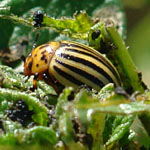
Contemporary microevolution in agricultural ecosystems. We mostly use the Colorado potato beetle adaptation to insecticides as a model system. This species is infamous for its remarkable ability to develop resistance to virtually every chemical that has ever been used against it. In some cases, a new insecticide failed after one year or even during the first year of use. We are investigating behavioral ecology and population genetics of this insect in an attempt to come up with management approaches allowing to extend the useful life of commercially used insecticides.
Recently we also got involved in more theoretic work reviewing existing resistance management requirements for insect-protected genetically modified plants.
Representative Publications:
Alyokhin, A. and Y. H. Chen. 2017. Adaptation to toxic hosts as a factor in the evolution of insecticide resistance. Current Opinion in Insect Science 21: 33-38. [E-mail to request a reprint]
Alyokhin, A. 2011. Scant evidence supports EPA's pyramided Bt corn refuge size of 5%. Nature Biotechnology 29: 577–578. [E-mail to request a reprint]
Baker, M. B., A. Alyokhin, A. H. Porter, D. N. Ferro, S. R. Dastur, and N. Galal. 2007. Persistence and inheritance of costs of resistance to imidacloprid in Colorado potato beetle. Journal of Economic Entomology 100: 1871-1879. [Full Text]
Insecticide testing program. Insecticides remain to be a foundation of insect pest management in commercial agriculture. Their safe and efficient use is impossible without a good understanding of ecological ramifications of toxin release in the environment. In cooperation with chemical companies, we conduct an extensive (up to 100 treatments per year) insecticide screening program on potatoes. We are mostly interested in insecticide impacts on target and non-target organisms, as well as on the spread of insect-vectored disease among potato plants.
Representative Publications:
Popov, S. Ya. and A. Alyokhin. 2019. Gender-specific acaricidal properties and sexual transmission of spirotetramat in two-spotted spider mite (Tetranychidae: Acariformes). Journal of Economic Entomology 112: 2186-2192. [E-mail to request a reprint]
Patterson, M. and A. Alyokhin. 2014. Survival and development of Colorado potato beetles on potatoes treated with phosphite. Crop Protection 61: 38-42. [E-mail to request a reprint]
Alyokhin, A., J. Makatiani, and K. Takasu. 2010. Insecticide odour interference with food-searching behaviour of Microplitis croceipes (Hymenoptera: Braconidae) in a laboratory arena. Biocontrol Science and Technology 20: 317-329. [E-mail to request a reprint]
Alyokhin, A., R. Guillemette, and R. Choban. 2009. Stimulatory and suppressive effects of novaluron on the Colorado potato beetle reproduction. Journal of Economic Entomology 102: 2078-2083. [Full Text]
To see everyday field operations of our insecticide program, please check out the video below: